

UK Paraformaldehyde Manufacturer and Supplier
Synthite is a UK paraformaldehyde manufacturer and supplier, producing paraformaldehyde prills at our Mold, North Wales site using a continuous production process directly integrated with our formaldehyde manufacturing operations. This vertical integration ensures consistent quality, supply reliability and responsive service for UK industrial customers who depend on solid formaldehyde chemistry.
2
Grade families (caustic-stabilised and TEA-stabilised)
91–97%
Formaldehyde content range across available grades
25 kg
Minimum pack size, with up to 1,000 kg available
Single-Site
Manufactured at Mold alongside formaldehyde production
What Is Paraformaldehyde and Why Is It Used?
Paraformaldehyde is a solid, polymerised form of formaldehyde supplied as free-flowing white prills. It provides a concentrated and controllable source of formaldehyde for industrial processes where water content, handling efficiency and dosing precision are critical.
A Practical Alternative to Aqueous Formaldehyde
Unlike aqueous formaldehyde solutions, paraformaldehyde contains no excess water, avoiding dilution effects in downstream processes and eliminating the need to manage additional liquid volumes.
As a solid material, it can be stored, handled and transported using standard packaging and infrastructure, reducing logistical complexity and improving operational flexibility.
Controlled Formaldehyde Release for Precision Applications
When heated, or dissolved to form a paraformaldehyde solution, it depolymerises to release formaldehyde in a controlled and predictable manner. This makes it particularly well suited to batch processes, chemical synthesis and applications requiring accurate, repeatable dosing.
Consistent prill structure and composition support uniform dissolution behaviour, helping maintain process stability and product quality.
Two Formats, Different Advantages
Choose what works best for you.
Aqueous Formaldehyde (Liquid)





Paraformaldehyde (Solid Prills)





Paraformaldehyde Production Process
Synthite operates a continuous paraformaldehyde production process at Mold, directly integrated with our formaldehyde manufacturing operations. This integration provides tight control over feedstock quality and process conditions, supporting consistent product specification and supply reliability.
From Formaldehyde to Paraformaldehyde
A carefully controlled process for consistent quality and reliable supply.

Formaldehyde Solution Concentration
A formaldehyde solution is concentrated to produce 82% paraformaldehyde as the raw material, using in-house formaldehyde with full quality control at source.

Stabiliser Addition
The paraformaldehyde is combined with a prilling agent, either caustic soda (for S-grades) or triethylamine (for LP and QP grades), depending on the grade being produced. This same agent also acts as the stabiliser, and its selection determines downstream handling, properties and suitability for specific application types.

Spray Cooling: Prill Formation
The stabilised paraformaldehyde mixture is spray-cooled, forming uniform white prills. Controlled cooling conditions produce consistent prill size and morphology, supporting predictable downstream handling and dissolution behaviour.

Fluid Bed Drying
Prills are dried on a fluid bed dryer to achieve the target specification. Drying conditions are controlled to meet the defined concentration range for each grade, from 91S through to 97S, and the LP/QP series.
Quality Control & Packaging
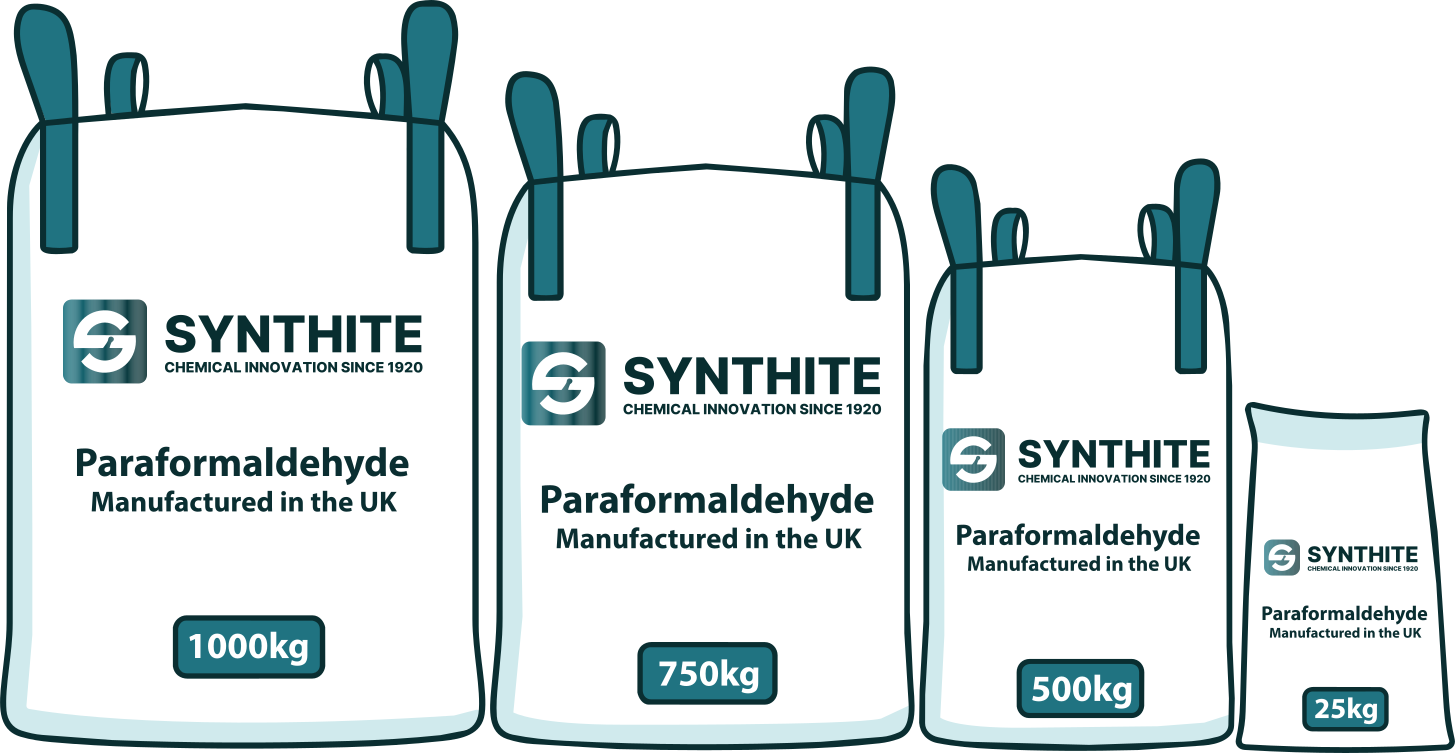
Finished product is tested against specification, documented, then packed to order, all carried out under ISO 9001 and ISO 14001 certified quality systems. Packaging ranges from 25 kg bags through to 1,000 kg bulk bags.
Integrated formaldehyde-to-paraformaldehyde production delivers tighter quality control and reduces supply chain risk.



Paraformaldehyde Grades Available
Synthite manufactures multiple paraformaldehyde grades to match customer requirements. Two distinct stabiliser chemistries are available, with grades selected according to formaldehyde content, downstream compatibility and process requirements.
Caustic-Soda-Stabilised Paraformaldehyde Grades:
- 91S, 92S, 97S paraformaldehyde
Triethylamine-Stabilised Paraformaldehyde Grades:
- 91LP, 92LP, 96QP paraformaldehyde (maximum achievable strength: 96%)
Paraformaldehyde Uses and Industrial Applications
Paraformaldehyde is used wherever a solid, precise, low-water source of formaldehyde is required. Its applications span resin manufacture, fine chemical synthesis, agrochemical production and a range of industrial processes requiring controlled formaldehyde delivery.

Paraformaldehyde for Resin & Polymer Production
Paraformaldehyde is used in the manufacture of synthetic resins, including phenolic resins, urea resins and melamine formulations. Its solid form allows precise dosing and reduces handling complexity in batch processes where controlled formaldehyde addition is required.

Paraformaldehyde in Agrochemical Synthesis
Paraformaldehyde serves as a building block in agrochemical manufacturing, where solid formaldehyde chemistry is preferred for process control and product formulation in pesticide and herbicide production.

Paraformaldehyde for Speciality Chemical Manufacturing
In fine chemical and pharmaceutical intermediate production, paraformaldehyde provides formaldehyde in a stable, easily handled form suited to precise chemical synthesis and where aqueous formaldehyde would introduce unwanted water into reactions.

Industrial Paraformaldehyde Applications
Paraformaldehyde is used in applications requiring controlled formaldehyde release, including fixation, preservation and sterilisation processes across industrial and research settings.
Why Choose Synthite as Your Paraformaldehyde Supplier
Synthite is the UK’s only independent producer of both formaldehyde and paraformaldehyde. The integration of these two processes at a single COMAH-regulated site creates supply and quality advantages that a standalone paraformaldehyde producer cannot replicate.

Only Independent
UK Producer

6 Grades Available
91S–97S · 91LP–96QP

Integrated Feedstock
Own formaldehyde source

25–1,000 kg Packaging
Bags to bulk IBCs

COMAH Upper-Tier
ISO 9001 & ISO 14001
Integrated Production, Feedstock Controlled In-House
Paraformaldehyde is produced directly from Synthite’s own formaldehyde stream at the Mold site. This means the quality, purity and consistency of the formaldehyde feedstock are fully known and controlled in-house, not sourced from a third party. The result is a more consistent finished product and fewer batch-to-batch variables.
Single Source for Both Forms of Formaldehyde
Customers requiring both aqueous formaldehyde and paraformaldehyde can source everything from Synthite under a single supply relationship, with shared quality documentation, consistent specifications and a single point of contact.
Upper-Tier COMAH Manufacturing, Operational Assurance
All paraformaldehyde is manufactured at Synthite’s COMAH upper-tier regulated site in Mold. For customers sourcing a hazardous chemical intermediate, this is a genuine safeguard: ongoing independent regulatory oversight.
Multiple Grades, One Supplier
With three caustic-stabilised grades and three TEA-stabilised grades available, Synthite can supply the most appropriate product for specific application and process requirements without customers needing to source from multiple producers.
Flexible Packaging for Any Scale of Operation
Packaging from 25 kg to 1,000 kg supports customers from R&D and pilot-scale through to full industrial production. This means Synthite can stay with customers at the early development stage through to scaled-up manufacturing, without them needing to switch suppliers as volumes grow.
Full Batch Traceability from Feedstock to Delivery
Because formaldehyde feedstock and paraformaldehyde production are both managed within Synthite’s ISO 9001 and ISO 14001 certified quality systems, full traceability from raw material through to finished packed product is available as standard.
Frequently Asked Questions
Yes. Synthite manufactures paraformaldehyde at its Mold facility in North Wales using an integrated production process linked directly to its formaldehyde manufacturing operations, ensuring secure UK-based supply and consistent product quality.
Paraformaldehyde (PFA) is a solid, polymerised form of formaldehyde supplied as white prills. It provides handling, storage, and transportation advantages compared with aqueous formaldehyde solutions.
Paraformaldehyde is preferred where solid formaldehyde chemistry is required, controlled formaldehyde release is important, or where reduced logistics complexity and the avoidance of excess water in processes are beneficial.
Synthite operates a continuous paraformaldehyde production process in which an 82% paraformaldehyde intermediate is stabilised using either caustic soda or triethylamine and spray-cooled into prills. The product is then dried in a fluid bed dryer to achieve the required specification.
By producing paraformaldehyde directly from its own formaldehyde operations, Synthite maintains tighter quality control, improves supply reliability, and reduces the risks associated with multi-site or third-party supply chains.
Synthite manufactures a range of paraformaldehyde grades to meet different industrial requirements. These include caustic soda-stabilised grades (91S, 92S, 97S) and triethylamine-stabilised grades (91LP, 92LP, 96QP), with maximum achievable strength up to 96% for TEA-stabilised grades.
Paraformaldehyde is available in packaging formats ranging from 25 kg to 1,000 kg, supporting both smaller batch processes and bulk industrial requirements.
Paraformaldehyde supplied by Synthite is used across resin and polymer production, speciality and fine chemical manufacturing, agrochemical synthesis, and other industrial applications requiring controlled formaldehyde release and precise dosing.
In resin and polymer production, paraformaldehyde provides a solid source of formaldehyde for phenolic, urea, and melamine resin systems. Its solid form enables precise dosing and simplifies handling in batch and controlled processing environments.
Paraformaldehyde is valued in fine chemical and pharmaceutical intermediate manufacturing because it supplies formaldehyde in a stable, handleable form without introducing unwanted water into chemical reactions.
Yes. Paraformaldehyde is used as a building block in agrochemical manufacturing, including pesticide and herbicide synthesis, where solid formaldehyde chemistry supports process control and formulation accuracy.
Synthite’s integrated UK manufacturing, operational redundancy, and ISO 9001 and ISO 14001 certified systems provide supply security, consistent quality, and long-term reliability. Ongoing multi-million-pound investment demonstrates a long-term commitment to UK manufacturing resilience.